June 19, 2012 11:39 pm
Purchase watercolors in 15 ml or 5 ml tubes not pan pigments or tin sets. I recommend professional grade watercolors by Winsor Newton or Holbein. Student grade paints are OK if you are on a budget but keep in mind they lack the quality of the former.
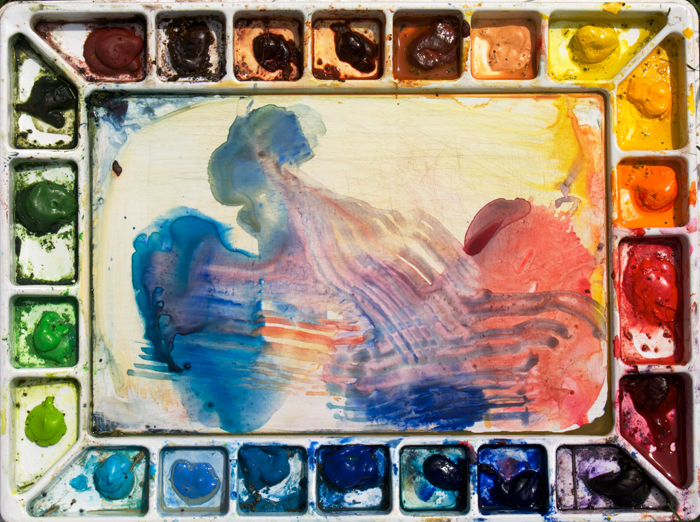
A good plastic palette with separate wells for pigments and a roomy mixing area is also essential. Make sure there are as many wells as you have tubes of color. Jones, Stephen Quiller, Robert E. Wood or Richeson are good brands.
Sable hair brushes, especially Kollinsky sables are the best watercolor brushes made. They are truly wonderful brushes yet are also usually very expensive. Good brushes will do your painting a world of good but keep in mind that an expensive brush doesn’t always mean that it is a good one.
As a relatively inexpensive alternative, look for good quality synthetic or synthetic blend brushes and make sure that the retailer suggests them specifically for watercolor. Robert Simmons’ line of watercolor brushes, Simply Simmons, are excellent brushes at a relatively low cost.
Here is a good assortment:
#4 Round
#8 Round
#12 Round
1” Flat
I recommend working in one of two ways: purchase a watercolor block – OR – stretch your paper.
In either case, you will need to work on 140 lb. Cold Press paper.
Watercolor blocks are convenient because it is not necessary to tape or staple the paper to a board. They are also handy for travel or plein air painting. They come in many sizes, weight and surfaces such as Hot Press, Cold Press and Rough. Make sure you are buying 140 lb. (300 gsm) COLD PRESS and nothing smaller than 10” x 14”. Common sizes are: 12” x 16”, 14” x 20” and 18”x 24”. If you are buying a block by Arches, make sure it has a green cover which is the correct weight and surface.
If you choose to stretch paper, buy full sheets (22” x 30”) of 140 lb. Cold Press paper. I will demonstrate how to tear and stretch paper on the first day.
Quality is very important in respect to paper. I recommend manufacturers such as Fabriano, Arches, Winsor Newton, Killimanjaro or Lanaquarelle.
If you choose to stretch paper, you will need to staple paper onto a surface. Always make sure your support is larger than the paper size you intend to work with. If you are painting on a watercolor block, support is in the form of the block itself.
Gatorboard or Incredible Art Board 16” x 24”, at ½” thickness
#2 pencil (I use a mechanical pencil which is great for contour drawing and reducing the amount of lead on the paper; look for HB in .5 mm, .7 mm or .9 mm.)
pencil sharpener
kneaded eraser
plastic container for water – Cottage cheese or Tupperware-like containers are good. A quart-sized plastic ice cream container is another good one.
plastic spray bottle – for water; select one that has an adjustable nozzle.
a large, natural sponge
Frogtape – the green masking tape found in the paint department at Home Depot or Lowe’s. It is used for taping down the watercolor paper to the board OR delineating the picture area if you wish to do so. Not necessary if you are stretching paper.
staple gun and staples – ONLY if you choose to stretch and staple your paper to your board. PowerShot is a good brand. A staple remover (the ones that look sort of like church key bottle openers) might also be a good idea…
paper towels – for wiping and cleaning your palette as well as blotting large areas of paint. The Viva brand seems more suited for watercolor.
Kleenex in small, travel packets – for blotting, picking up runaway paint and more subtle absorbency uses.
an iPad – certainly not a requirement though if you have one, it is a great tool as viewfinder and camera for recording subject matter.
viewfinder – very helpful while composing and drawing. You can also make one by cutting a rectangle into something like matboard – just be sure to make it proportional to the dimensions of the paper you are painting on!
portable brush holder – to protect your investments! These can be the roll-up, placemat types or the folding kind with elastic straps for securing the brushes.
old toothbrush – for splattering and scrubbing
palette knife or pocketknife with a large, rounded blade.
hair dryer – to save time waiting for washes to dry. A mutli-speed hair dryer works best.
Crafts & More
506 Beach Blvd.
Jacksonville Beach, FL 32250
craftsandmorefl@bellsouth.net
904-241-0093
Reddi-Arts
1037 Hendricks Avenue
Jacksonville, Florida 32207
904-398-3161 (phone)
Daniel Smith, Inc.
P.O. Box 84268
Seattle, WA 98124-5568
800- 426-6740
http://www.danielsmith.com
Cheap Joe’s Art Stuff, Inc.
374 Industrial Park Drive
Boone, NC 28607
800-227-2788
www.cheapjoes.com
Jerry’s Artarama
PO BOX 58638J
Raleigh, NC 27658-8638
800-827-8478
www.jerrysartarama.com
Dick Blick Art Materials
P.O. Box 1267
Galesburg, IL 61402-1267
800-828-4548
www.dickblick.com
Posted by Robert Leedy
Categories: Uncategorized
Tags: art materials, art supplies
Mobile Site | Full Site
Get a free blog at WordPress.com Theme: WordPress Mobile Edition by Alex King.
[…] The cost of the six week class is $200. That is a total of 18 hours of instruction. Art supplies are not included. Here is the supply list. […]
By Summer Watercolor Classes with Robert Leedy | Robert Leedy Watercolors on June 10, 2013 at 11:47 pm